


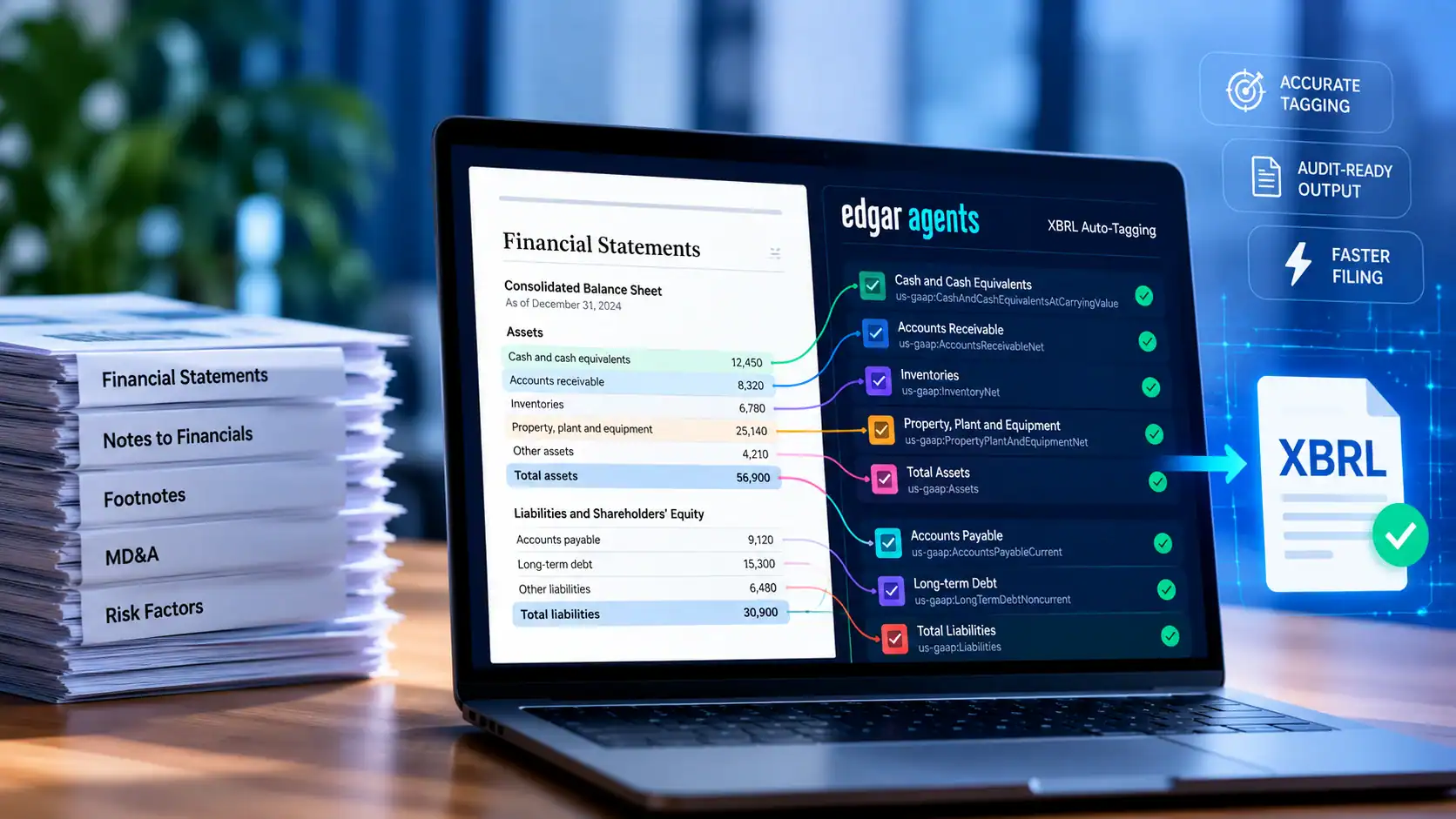

AI-Powered Auto-Tagging
Tagged in Hours, Not Days
Intelligent automation reads financial values, disclosures, and notes, matching each fact to the correct taxonomy element with a statistical confidence score. Purpose-built for new registrants, IPOs, and new disclosures with no prior filing history.

Seamless Roll-Forward
Frictionless Continuity
Your prior-period structure converts into the new draft with approved tags, dimensions, scale, and dates intact. The structure you signed off on last quarter is the exact structure you receive this quarter.

Continuous Data Quality
Audit-Ready Before Submission
Automated checks run continuously against SEC EDGAR Filer Manual (EFM) requirements and Data Quality Committee (DQC) rules throughout and in parallel with the drafting process – not just at the 11th hour – flagging conflicts without disrupting workflow, without idle time, and well before they become SEC comment risks.

Auto-Onboarding
Proven in Live Production
Switching to EdgarAgents doesn't risk your filing history. We extract and import your existing public iXBRL filings directly, transferring your custom taxonomy extensions and structures into production, typically in under 30 minutes.

100% Named Expert Sign-Off
Dedicated Specialists
Our seasoned analysts and filing specialists review every tag. Your working group can view tags, comment, and approve alongside our team via our collaborative, secure web review application.

Private AI & Governance
Closed-Model Architecture
Closed, proprietary AI runs strictly inside our secure, SOC 2 compliant perimeter. Your confidential financial disclosures never train any public or internal models. The machine accelerates tagging; human experts retain 100% accounting judgment.

Step 1
Auto-Onboard
Import existing iXBRL filings directly from EDGAR, carrying forward your structure and taxonomy seamlessly.
Step 2
Intelligent Tag
Private AI matches new disclosures in hours, while Roll-Forward preserves established tagging structures.
Step 3
Continuous Validate
Automated EFM and DQC validation engines check math, scaling, and dimensions throughout drafting.
Step 4
Expert Quality Check
A named EdgarAgents analyst reviews every line item and delivers an audit-ready iXBRL package ready for filing. Nothing gets outsourced.

Tight Filing Deadlines
From initial document input to delivery, an average-sized 10-Q takes under 15 hours.

Last-Minute Draft Changes
Numbers shift right up to the wire. Our specialists implement late changes rapidly without breaking taxonomy links.

Complex Validation Conflicts
Our analysts explain what must be corrected and what can be safely ignored, clearly isolating conflicting data points.

Lean Internal Reporting Teams
Whether answering “does this disclosure need a tag?” or resolving intricate custom extension warnings, our team covers the entire compliance burden.